





← Go Back
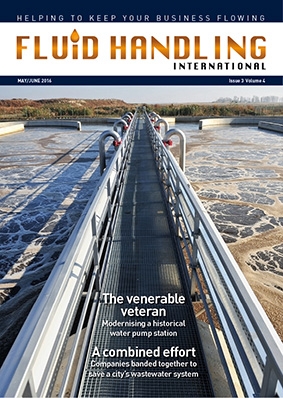
Volume 4, Issue 3
Fast action for safety
Feature
In a small yet significant amount of applications where Class VI sealing and double block and bleed is required, there exists a limited amount of possible valve choices for the customer. Usually this type of tight shut-off requires a valve with resilient seating. But first, a misnomer that has existed for years has to be clarified. There is a difference between...
[read more]
Disasters waiting to happen
Feature
Many lime storage silos at water treatment plants are disasters waiting to happen, putting lives at risk and posing serious threats to the environment. Water companies are already under pressure to minimise the impact of treatment works on the local environment, especially in terms of odour and pollution. The potential for dust pollution from storage silos with ill-equipped...
[read more]
The many colours of the butterfly
Feature
Butterfly valves are being used more and more in modern piping and distribution systems. They offer the user a cost-effective alternative to more traditionally used valves such as ball, diaphragm, gate, and globe valves. Butterfly valves, depending on specification are designed to handle a wide range of conditions and media including corrosive chemicals,...
[read more]
Dampening the blow
Feature
Actuated dampers are key to the provision of efficiency and safety in numerous environments affecting industry and the public at large. Critical applications are found in areas as diverse as road and rail tunnels, mines, offshore platforms, commercial shipping, cruise liners, power stations, and process industries. In each environment, the correct...
[read more]
Researching safety
Feature
In the early 1990s, representatives of many of the major oil and gas producers surfaced concerns related to the causes of chatter, flutter, and cycling (as defined in the API 520 Standard) specifically in the operation of direct spring-loaded pressure relief valves. They were seeking a tool to determine the conditions...
[read more]
Resolving water hammer through transient monitoring equipment
Feature
"Water hammer" is a serious concern for municipalities today in order to ensure water quality and keep fluid distribution pipelines operating efficiently and consistently without expensive downtime. Whether the application is pump station control, pressure/flow balancing, or age of water, a systematic approach is needed to prevent potentially catastrophic events from...
[read more]
The saint of sewage
Feature
The Twin Cities Rescue Mission in Marysville, California, has been plagued by a sewage pump that constantly plugged up and broke down. Twin Cities Rescue Mission aims to provide a clean and sober community, assisting in housing and also providing food, clothing, and showers for anyone in need. It also provides a religious atmosphere and works to promote...
[read more]
The Yin and Yang
Feature
It is estimated that on average there may be one rough vacuum pump for every three compressors installed on a production site. However, in many cases they can be found operating at minimum performance levels in remote areas, which represents an uneconomic burden in terms of energy consumption. This is ironic considering that state-ofthe- art air...
[read more]
A combined effort
Feature
As storms and torrential rain hit Granbury, Texas, back on Sunday 10 May, 2015, what the city's residents were not expecting to find as the rain subsided the following morning was a large sinkhole in the lakeside parking lot outside Brookshire's supermarket. Measuring over 90ft wide and 30ft deep, what was initially thought to be a sinkhole turned out...
[read more]
The venerable veteran
Feature
Thames Water is the UK's largest water and wastewater services company, supplying around 2.6 billion litres of tap water to more than nine million people across London and the Thames Valley area. One of Thames Water's biggest abstraction facilities is the Littleton Raw Water Pump Station (RWPS) in Surrey, UK. Built between 1923 and 1925, the...
[read more]
The good ol' boy
Feature
Within the papermaking industry, removing water at the earliest stage in the process speeds up the formation of a hard, strong, consistent sheet whilst also reducing web breaks and water removal costs. This is typically performed by low vacuum fans. However, further along the production line there are stages where higher vacuum levels are required to...
[read more]
Ultrasonic on the rise
Feature
The history of ultrasonic flowmeters goes back to the early 1960s. Ultrasonic flowmeters were first introduced for industrial use in 1963 by Tokyo Keiki in Japan. In 1972, Controlotron (now part of Siemens) became the first US manufacturer to market ultrasonic flowmeters in the US. In the late 1970s and early 1980s, both Panametrics (now part of GE...
[read more]
A novel approach
Feature
Across the industrialised world there is an increase in demand for liquid flow measurement systems operating at low flow rates. The range of applications that might benefit from such systems is wide, including offshore, industrial, medical, food, beverage, pharmaceutical, and laboratories. The requirements on flowmeters to fulfil these applications...
[read more]
Houston, we have a show
Feature
ILTA's annual international operating conference and trade show in Houston, Texas, on 23-25 May brings together thousands of terminal industry professionals to exchange information, identify best practices and find the latest in equipment and technology. But what can you expect to find amongst the dozens of exhibitors?
Keep it in the tank
Feature
Tanks and drums containing hazardous and flammable liquids require secondary and tertiary protection to prevent potential accidents, such as the Buncefield fire in Hertfordshire, England, in 2006, which left 45 people injured. Lessons learned from that accident were translated into effective and practical guidance that industry would implement as...
[read more]
The high-pitched snitch
Feature
It is axiomatic in many industrial, process, and scientific environments that "everything leaks". What is critical is to know how much is the leak rate, and sometimes where the leaks are. Manufacturers and process systems operators who are under great pressure to improve yields, extend maintenance cycles, meet regulatory requirements, reduce costs, and...
[read more]
Steam vs thermal fluid
Feature
Steam has been a valuable servant to the human race, from a means of powering engines to a method of cooking food. However, there is one area where steam has been outdone in recent years – heat transfer using thermal fluid. Historically, if heat transfer was needed in a chemical process and heating via naked flame was not feasible, steam was the...
[read more]
From the vacuum they came
Feature
Manufacture of valve castings is a methodical process, which starts from making wooden patterns, proper methoding (creating a plan for a mould), making the mould, adding the steel scrap metal into the furnace, and pouring the molten liquid into the pits, which gives the valve the shape that is required. Selection of proper methoding is crucial for...
[read more]