





← Go Back
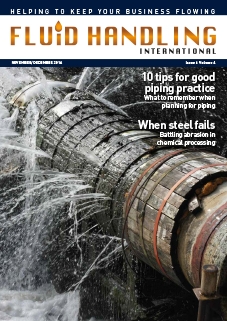
Volume 4, Issue 6
10 tips for good piping practice
Feature
Here at Crest we want to ensure that our pumps are always working at their most efficient level. To achieve this, we are often reliant on external factors, such as an effective piping design. Sometimes there is a pressure to save money on piping, but experience shows us that this can often affect pump operation or, in some cases, result in a large repair bill. First, the good news. The piping...
[read more]
A cool solution
Feature
Pipework users across the entire industrial spectrum, but particularly in the petrochemical sector, regularly face the difficulty of having to repair or replace pipe sections or change in-line components such as valves and instrumentation. The widely used but arguably expensive and time-consuming solution is to access the affected section by draining and drying the pipes. However, the contents...
[read more]
Design under pressure
Feature
Industrial processes in the oil, petrochemical, chemical, and energy sectors have evolved to use ever higher pressures. The use of high pressure has been found to improve efficiency and reduce costs. Moreover, the introduction of new production methods to meet the changing needs of the industry has led to technological advances. These developments have resulted in the sharp increase in demand for...
[read more]
Walrus-sized solutions
Feature
As an engineer in the field, there is nothing more infuriating than finding you have the wrong size or type of fitting to complete the job. No matter how well stocked the van is, it is impossible to carry every component for every eventuality. This is ever more so the case in the fluid handling industry, and specifically with hose clamps. With an almost never-ending list of types –...
[read more]
Sweet relief
Feature
Industrial customers throughout the world who are responsible for the safety and integrity of aboveground andunderground storage tanks look to their trusted advisors and suppliers for tank protection products and solutions that deliver a broad range of benefits to their operations. Namely, enhanced productivity and performance, reduced emissions and waste, and lower costs are among some of the...
[read more]
What the Germans want
Feature
Everyone involved in valve manufacturing knows that German industry has very strict regulations and norms that manufacturers must carefully fulfil in order to be approved for different applications. The German chemical industry, for example, requires valves to be in compliance with the AD2000 Merkblatt code of practice for the choice of materials and sub-supplier. Another important mandatory...
[read more]
How much will your pump really cost you?
Feature
When it comes to specifying pumping equipment, many companies, particularly those under increasing pressure to cut costs, could actually be making decisions that will cost them more in the long run. Lifecycle costing can help to reveal the true cost of a pump. The need to cut costs wherever possible is an increasingly familiar requirement for engineers charged with ensuring the continued smooth...
[read more]
Screwing it into place
Feature
Located in Lincolnshire, UK, the town of Grimsby's Freshney pumping station is a key element of its flood defences, which were first enshrined in statute way back in the Grimsby Haven Act of 1796. Whenthe pumping station was first built more than half a century ago, it was equipped with three large Archimedes screw pumps. These were replaced some years later, but time and exposure to the elements...
[read more]
Efficient solutions preferred
Feature
A malfunctioning pump can cause massive damage, and hence high costs – even just in terms of downtime and loss of production. On top of this come the costs of repair work and the time requirements, all of which impact the total cost of ownership (TCO). Up to 90% of damage to pump systems is the result of deficiencies in the design of the pump or operating errors. When selecting the...
[read more]
Lifting a standard
Feature
Lift stations are a key link in the chain of wastewater collection and treatment. Traditional lift stations use submersible pumps in a wet well, which are activated by float switches when the water reaches a preset level. The pumps then run at full speed to empty the wet well. A primary issue with submersible pumps in wet wells is clogging with wipes and other flushable materials. The float...
[read more]
When steel fails
Feature
To extract zinc from ore, such as zinc sulphite, the ore has to be heat-treated first to obtain calcine (Zno). Then, the calcine is leached with sulphuric acid to solubilise the zinc, which is later electrolysed to deposit on a cathode. Afterwards, the zinc is melted and casted to obtain ingots. Zinc is mainly used for the manufacturing of different kinds of stainless steel. This manufacturing...
[read more]
Hurry along to Düsseldorf
Feature
Valve World Expo will draw the best and brightest of the valve and flow management industries to Düsseldorf in Germany on 29 November – 1 December. In this preview we give a small sample of all the things to see
A finger on the pulse
Feature
There are many situations where reliable flow monitoring is required. Beyond simply measuring flow rate, further monitoring may be needed from measuring the flow throughout a process network, identifying flow movement or valve failure, and initiating pig deployment to clean pipework to confirming the efficient operation of pumps. The traditional solution is a magnetic flowmeter installation, but...
[read more]
Save your production
Feature
Ethylene is used as a critical feedstock for many petrochemical products, including polyethylene, ethylene oxide, and polyvinyl chloride. Ethylene is typically transferred in mass flow units (lbs, kg, etc.) and it has a critical temperature of 9.5°C, which is lower than many fluids. Above the critical temperature of a fluid, no matter how high the pressure goes, the fluid does not pass from a...
[read more]
2017: The year of oil
Feature
Flowmeters play a vitally important role in the oil and gas industry. Oil and gas are both measured many times as they move from the wellhead to a gas processing plant or refinery. The output of a gas processing plant includes gases such as nitrogen, oxygen, helium, and carbon dioxide, while major products output from a refinery includes petrol, jet fuel, and heating oil. All these products are...
[read more]
Engineering safety
Feature
A question asked often in the liquid handling business is "What is new?" In many cases it is an enquiry made in the hope that someone, somewhere, has devised a new and ingenious method for providing complete safety of operators on tanker tops, with an installed cost of practically zero. So what has changed? Gravity remains the primary issue. Concrete comes a close second. However, tanker heights...
[read more]
A hot food line
Feature
Britain is a nation that loves its food. A staggering 1.5 million cans of Heinz baked beans are sold every day in the UK. Food production is a very important part of the country's culture and economy, so when it comes to the processes responsible for food manufacturing, maintenance and regulation are of the upmost importance. It is reported that there are around 4,000 companies operating thermal...
[read more]
Adhesive bonding technologies and applications
Feature
Virtually every product assembled requires bonding or sealing at some stage of the process. Manual and automated technologies for single-component and two-component bonding and sealing are available for a broad array of applications. Adhesive bonding is the process of joining two work pieces securely by using a liquid or semi-liquid material to create a long lasting bond. In a high-volume...
[read more]