← Go Back
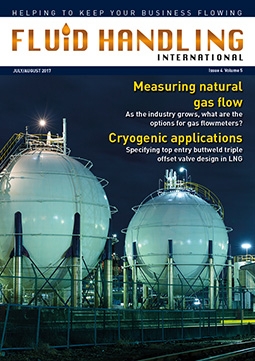
Volume 5, Issue 4
Options for measuring natural gas flow
Feature
The use and measurement of natural gas is growing as environmental concerns increase. Global warming and the world’s emission of fossil fuels has become such a critical issue worldwide that most countries are trying to reduce their greenhouse gas emissions and also search for renewable sources of energy. For many years coal and oil have been the dominant sources of energy in many countries....
[read more]
Gas flow measurement as a cash register
Feature
The flow measurement of multipath transit time ultrasonic meters (USMs) is a vital function because USMs ultimately act as cash registers, measuring gas volume as it moves between businesses within a natural gas supply chain. It’s a high-risk process: the smallest measurement inaccuracy can lead to a substantial financial loss because of the high volume of gas flowing through a pipeline at...
[read more]
The case for top-entry in cryogenic LNG
Feature
The requirement for a port entry in buttweld valves in the LNG industry has become extremely common. The end user’s key objective is to align with regulatory requirements such as EN 1473 or NFPA 59A and comply with local regulation (especially for LNG terminals). For this reason, specifying valves with a lower amount of flange connections is critical and welding valve bodies to the pipe...
[read more]
Gland packing vs. mechanical seals
Feature
Why would you choose to use mechanicalseals over gland packing? Why would you choose the more expensive option if you’re already coping with your currentmethod? Is it really any better? Naturally there are advantages to both sealing methods but firstly let’s understandwhy gland packing is still popular. Quite simply gland/pump packing is a tried, tested and relatively...
[read more]
A seal for life
Feature
A major Romanian oil company approached OPW to provide an easy to install, reliable above ground fill point solution for a new build filling station including associated internal equipment (pipework and fill caps) that would perform for the life of the site. The oil retailer required an above ground remote fill sump which would allow safe and fast access to fuelling points for tanker drivers...
[read more]
Analyse this (fluid flow)
Feature
Through effective data analysis, both a university and an LNG plant have seen huge benefits. The collection, retention and analysis of data is everywhere, from supermarkets to election campaigns. The insights that can be gained from big data collections are hugely valuable to a multitude of industries, and that includes a host of fluid handling applications. Developments in technology and...
[read more]
Interview: trends and challenges in automation and instrumentation
Feature
A Q&A with Ryan Spooner, Automation & Instrumentation Engineering manager for Singer Valve. Singer Valve is a global manufacturer of hydraulic operated water control valves. These control valves operate in applications such as upstream/downstream pressure control, flow control, altitude control and surge/ pump control in the municipal, industrial and fire industry. Singer Valve offers...
[read more]
Getting it right with AODD pumps
Feature
In a variety of applications across a number of industries, air-operated double diaphragm (AODD) pumps provide reliable, high performance pumping. They have come to be known as the “work horse” of industry when it comes to handling and transferring fluids at relatively low flows and pressures. Above ground or below ground, onland or on sea, in normal or extreme conditions, the...
[read more]
Is peristaltic the answer?
Feature
A quick internet search of the term peristalsis will swiftly lead to a screenfull of images of the human digestive system. More than just being a biology lesson however, this gives an insight into a form of pump design that is popular in a range of applications involving some of the most complicated media. The US National Library of Medicine’s MedlinePlus website defines peristalsis as...
[read more]
What will the pump of the future look like?
Feature
Few components in plant and equipment engineering are as steeped in tradition as the pump, but how does this fit in with the age of digitalisation? Is it even possible to design a hydraulic element that is fit for Industry 4.0? KSB has been reconciling these two worlds successfully for some time now. KSB has always focused primarily on the optimisation of pumps – knowing the exact load...
[read more]